
Lessons from the tragic Annunciation Catholic Church shooting in Minneapolis
We must restore medical and support system safeguards to address underlying mental illness in gender-distressed youth.

“The original safeguards on the practice of pediatric medical transition (PMT) have been systematically dismantled in the U.S.”
—Treatment for Pediatric Gender Dysphoria;Review of Evidence and Best Practices (U.S. Department of Health and Human Services, May 1, 2025), p. 179
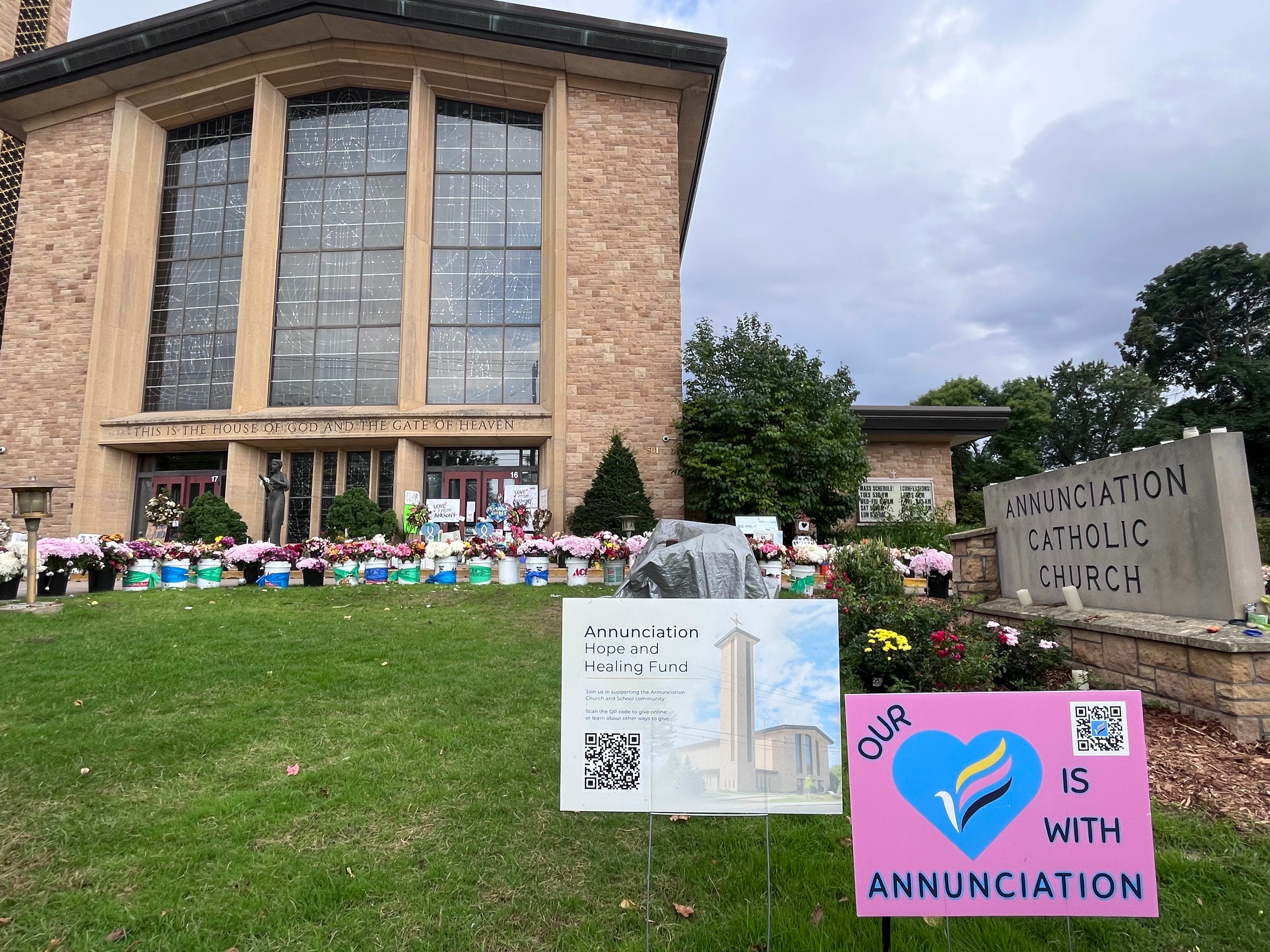
In the wake of the mass shooting at the Church of the Annunciation (Minneapolis, August 27), in which two children tragically lost their lives, mainstream media focused on the need to ban guns, particularly assault weapons. Equally urgent, however, is the need to address untreated mental illness in gender-distressed youth such as the alleged perpetrator, Robin (born Robert) Westman.
Westman’s own writings suggest that he suffered from severe mental illness and was “tired of being trans.” For patients contemplating gender transition, it is especially critical for practitioners to address underlying mental illness, yet a strategic, widespread, and well-funded lobbying campaign to stifle medical safeguarding has succeeded in a short period of time. The standards that need to be reimplemented include an abundance of published peer-reviewed clinical guidelines, models of care, and best practices. Three key evidence-based systematic reviews documenting these standards of care practices (among many other scientific studies) are presented.
Do No Harm
Why do mental health practitioners and care support systems avoid addressing mental illness and other conditions when associated with so-called “gender-affirming care”?
Why do state laws, professional medical association policies, and even clinical guidelines (for example, World Professional Association for Transgender Health, WPATH) restrict, even prohibit, mental health workups in evaluating patients for gender transition?
All licensed health professionals, including those in my own field of clinical pharmacy, are taught early on how to evaluate the medical literature for the safety and effectiveness of therapies. The “gold standard” of evidence-based medicine, typically found in peer-reviewed journals, consists of: (1) the randomized controlled trial, (2) meta-analysis, and (3) systematic review. These form the basis for developing the guidelines and best practices clinicians rely on to examine (work-up), recommend, and implement individualized treatment plans. Evidence-based medicine enables health professionals to weigh risks against benefits and to uphold our fundamental oath to “do no harm.”
Restrictions on Health Care Practitioners
In contrast, where youth gender transition is concerned, licensed health professionals, including those in mental health, face restrictions on discussing and working up potential underlying mental illness and co-occurring conditions such as opioid addiction and substance abuse.
Since 2023, for example, Minnesota has prohibited mental health practioners and professionals from engaging in so-called“conversion therapy” with a minor or a vulnerable adult. “Conversion therapy” is defined broadly as “any practice that seeks to change an individual’s sexual orientation or gender identity.” Significantly, “conversion therapy does not include counseling, practice, or treatment that provides assistance to an individual undergoing gender transition.”
If a diagnosis of mental illness were to emerge from a patient workup, could the clinician who recommended against gender transition face punishment for “conversion therapy”?
In Minnesota, such treatment “shall be considered unprofessional conduct that may subject the mental health practitioner or mental health professional to disciplinary action by the licensing board of the mental health practitioner or mental health professional.” (Here is a list of other U.S. states that ban “conversion therapy.”) For more on the history of “conversion therapy,” see below.*
Removal of parental consent
Laws in many states now also remove parental consent for gender transition in doctor’s offices, while taking at face value the wishes of the child. Most major life decisions by minors, especially life-altering medical decisions, should always involve parental consent. This cannot be emphasized enough in the digital age of addiction to social media, which can damage mental health and spread contagion. Yet school policies now also sideline the parents of gender-confused children (see below for more information on this.)**
Here is the evidence documenting the well-funded campaign to remove the safeguard of parental consent: ‘Only adults? Good practices in legal gender recognition for youth; a report on the current state of laws and NGO advocacy and eight countries in Europe with a focus on rights of young people” (November 2019).
“Its purpose is to help trans groups in several countries bring about changes in the law to allow children to legally change their gender, without adult approval and without needing the approval of any authorities.”
As the Report states, and I quote:
“In short, this is a handbook for lobbying groups that want to remove parental consent over significant aspects of children’s lives. A handbook written by an international law firm and backed by one of the world’s biggest charitable foundations.”
Thus, the health care system, and all sectors that constitute support systems have been systematically stifled when it comes to trans-identified patients, especially children and young adults. The Westman shooting in Minneapolis is a case in point.
In other words, there is widespread pressure, including new state laws, to ignore workups for potential underlying mental health issues, while fully prioritizing “gender-affirming care.” The UK Cass Review, a meta-analysis (highest level of evidence), presented below, emphasizes the current collapse of medical safeguarding. It’s as though the objective, evidence-based data have been ignored, or more correctly, suppressed and distorted.
Yet objective data exists. Until recently, I, too, was unaware of the extensive studies carried out in this field. After reviewing the literature for more than two years, I present three key evidence-based reviews (among an abundance of other scientific studies) which should be guiding the treatment plan for trans-identified patients. At the very least there needs to be recognition of the limits of such treatment, especially in the pediatric and young adult populations, and the dire need to, again, address underlying mental illness and other comorbidities, including the opioid epidemic, and other substance abuse, in the medical workups of such patients.
Ultimately, gender therapy decisions, like other physical and mental health care decisions, should include wider support systems, including family, friends, community, and school, in addition to interdisciplinary practitioners, based on best practices. Currently, across the board, professional and nonprofit health care and mental health organizations all have succumbed to pressure to take at face value, without a detailed workup, including past mental health history or current history of patient illness, any patients who present seeking “gender-affirming care”.
The most frequent ICD diagnosis codes I see on prescriptions, coded by health practitioners, for which cross-sex estrogen and testosterone hormones are prescribed, are: F649, “gender identity disorder”; or F640, “transsexualism”. (ICD stands for International Classification of Diseases.)
The one exception I could find thus far derives from Minnesota’s public Medicaid program’s Provider Manual, in which psychosocial assessment is required prior to transgender surgery. For minors, authorization requires a written referral from a multidisciplinary team of medical and mental health professional.
Without such medical safeguards, the transgender surgery “market” and “revenues” will continue to drive the decision-making, see bar graph:
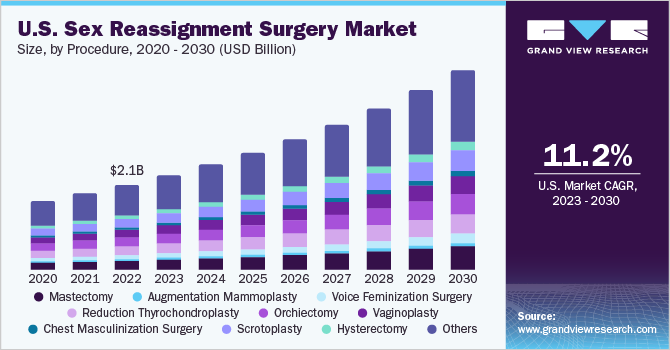
From the above source, prominent players in the profitable U.S. sex reassignment surgery market include:
• Icahn School of Medicine at Mount Sinai
• Cedars-Sinai
• Moein Surgical Arts
• Cleveland Clinic
• Transgender Surgery Institute
• Plastic Surgery Group of Rochester
• Regents of the University of Michigan
• CNY Cosmetic & Reconstructive Surgery
• Boston Medical Center
• The Johns Hopkins University
• Kaiser Permanente
• University of California, San Francisco Center of Excellence for Transgender Health
• New York Presbyterian Hospital
• Mayo Clinic (Transgender and Intersex Specialty Care Clinic)
Background and Context
Many are beginning to ask: how have the transgender movement and transgender therapy emerged in such a short period of time? Growing evidence suggests that “trans” is not largely a grassroots movement but rather a policy imposed from above.
Role of the Corporate Health Care industry
Journalist Jennifer Bilek among others are documenting the top-down role of for-profit corporate health care industries and the organizations they heavily fund, which drive the ideology while omitting the science. A complete review of this “commodification” is beyond the scope of this article. For further reading, see The Transgender Money Pipeline.
Robin Westman as case in point
I begin with a commentary by historian and Substack writer Matt Osborne about alleged Annunciation shooter Robin (Robert) Westman. Osborne begins with a key quote from Westman’s own journal writings or manifesto as follows:
Evidence of desire to de-transition
“I am sick of my hair, I want to chop it off. I only keep it because it is pretty much my last charade of being trans. I am tired of being trans, I wish I never brain-washed myself. I can’t cut my hair off now as it would be an embarrassing defeat, and it might be a concerning change of character that could get me reported. It just always gets in my way. I will probably chop it on the day of the attack.”
Evidence of underlying mental illness
In other parts of the journal, Westman — who changed his legal name from Robert to Robin in 2020, after applying when he was 17 — said he had been suicidal for several years (a red flag for severe mental illness) but wanted to take others out with him.
“I don’t want to [do] it to spread a message. I do it to please myself. I do it because I am sick,” he wrote.”
“I don’t think I could just take myself out. I would need to do something with my final act,” the journal continued.
Uniquely among all other major media, however, the CNN article of the shooter’s journal writings, quoted below, stands out for its focus and findings indicating untreated,underlying mental illness, and Westman’s many pleas for help (compared with, for example, the Minneapolis Star Tribune and the New York Times, both of which focus almost exclusively on gun violence, except for the NYT article reporting Westman’s former art teachers’ observation of his forearm injuries which she described as a cry for help or self-hatred or both).
Here are the key quotes (emphasis added):
“As Minneapolis reels from the shooting, officials are combing through Westman’s rambling writings – which the shooter shared in YouTube videos timed to go online around the same time as the attack – to search for a motive.”
“A CNN review of dozens of those pages – most written in Cyrillic letters to mask the disturbing content – raises questions about whether people in Westman’s life missed warning signs that could have prevented Westman from purchasing the array of firearms used in the killings.”
“Even as Westman carefully plotted out the attack, writing as recently as last week about visiting the church, diagramming the interior and testing out weapons, the shooter also hinted at a desire to be caught. After describing a family member who had remarked on “dark energy” surrounding Westman, the shooter wrote: “FIND ME I AM BEGGING FOR HELP, I AM SCREAMING FOR HELP.”
“While police have described the writings as a “manifesto,” CNN’s review found that the hand-written entries are less a coherent statement of purpose or political declaration and more a jumbled, stream-of-consciousness window into the shooter’s troubled state of mind.”
“This is not a church or religion attack, that is not the message,” Westman wrote. “The message is there is no message.”
The journal entries provide a disturbing and extensive look at Westman’s private thoughts. The shooter described working to avoid detection, writing the entries in Cyrillic script as a “cypher” in case someone found the notebook.
“I really just want a place to put my thoughts,” Westman explained. “I can’t talk to a therapist or family cause I will immediately be reported and put on a watchlist!”
“Westman had suffered from depression and faced suicidal and homicidal thoughts for years, according to the journal.”
“I have a loving family and a good support system of people that want to see me thrive,” Westman wrote. “For some reason, the fact that I have a pretty good life and the fact that I want kill people have never correlated to me.”
“Every school I went to, I have some fantasy at some point or another of shooting up my school,” Westman added. “Even every job.”
At the time, according to a journal entry, Westman asked a girl, “if there was a school shooting, where would you hide?” But after the student told adults, Westman was suspended from school for a week, the journal says.
“I basically promised I didn’t mean anything,” Westman wrote, adding, “I don’t remember ever talking to a therapist.”
Westman had no past criminal record, according to police and court records.
In a more recent entry, Westman wrote, “I don’t want to f**king do this I hate myself. I cannot turn back. I cannot stop myself.”
“I feel like my mom would have seen it coming due to my rocky past with violent threats,” the journal states. “The other day my stepmom… said she could feel a ‘dark energy’ around me… if only you know!”
“Minneapolis Police Chief Brian O’Hara said at a press conference Thursday that authorities are not aware of Westman having any prior mental health diagnosis or mental health commitments, which could have prevented Westman from purchasing firearms.”
Thus, two analyses of Westman’s journal writings and actions calling for the need to detect underlying mental illness in youth contemplating transgender care:
• Osborne commentary quoted here
”For those of us familiar with the trenches of this culture war, it is not surprising that Robert Westman got tired of the exhausting charade of being Robin. We are also not shocked to learn that his homicidal-suicidal ideation went unaddressed while his supposed gender identity received generous attention from parents, teachers, counselors, and the community. This is normal with genderwoo. Comorbid conditions are always overshadowed by the diagnosis.”
• For more on the preoccupation with gender identity while ignoring underlying mental illness, here is another key article from evolutionary biologist Colin Wright:
“What we are dealing with is primarily a mental health crisis—yet one that has been dramatically intensified by ideological distortions of reality that have captured activists, policymakers, and our medical institutions.”
What do evidence-based studies show?
Here are the three key evidence-based reviews (among an abundance of other scientific studies).
1.Cass Review, (2024). 388 pages. Independent review of gender identity services for children and young people, final report.
Key sections:
“Overview of Recommendations”
“The recommendations set out a different approach to healthcare, more closely aligned with usual NHS clinical practice that considers the young person holistically and not solely in terms of their gender-related distress. The central aim of assessment should be to help young people to thrive and achieve their life goals.”
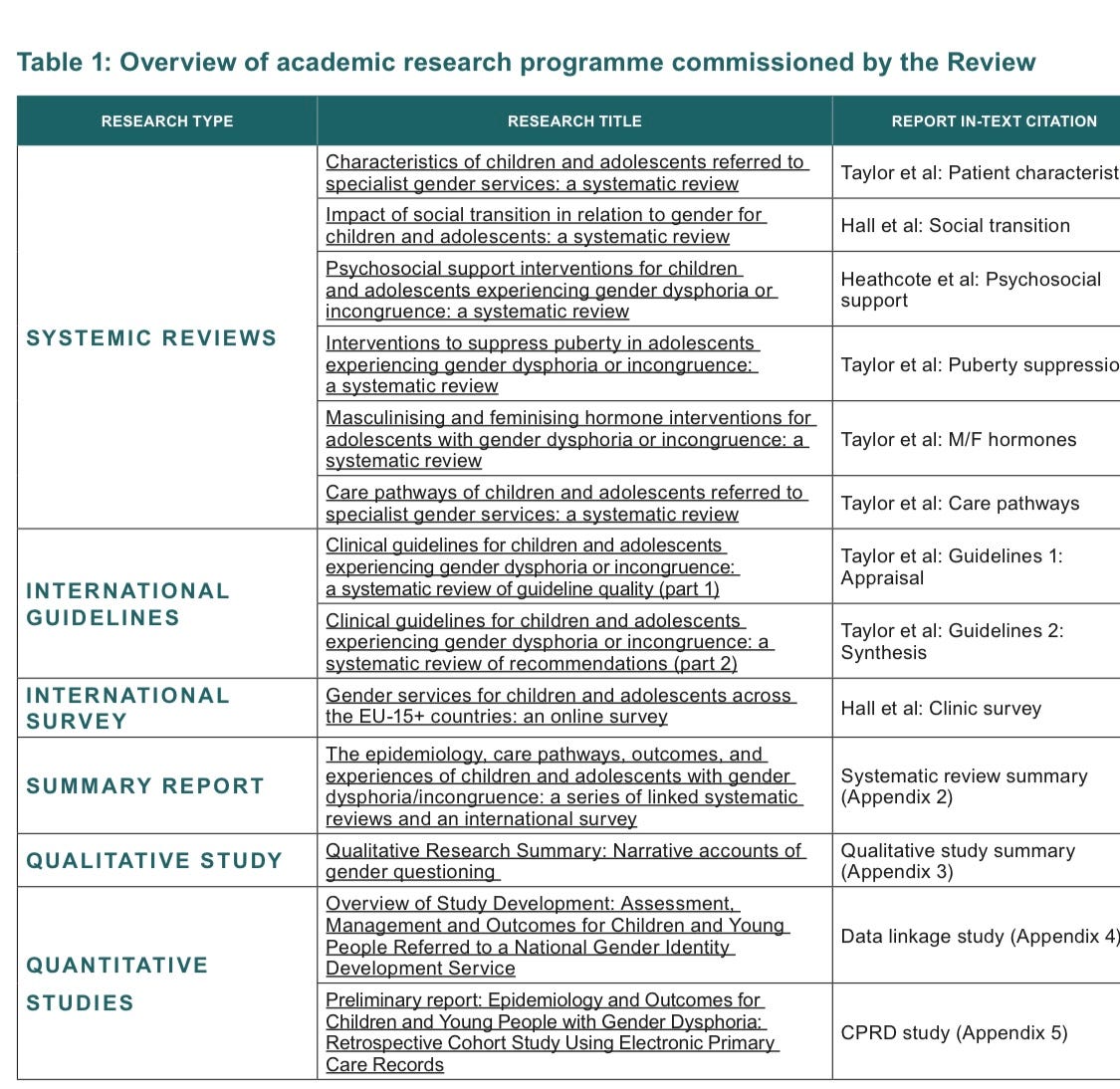
Methodology section, p. 47
1.12 p.53 The aim was to provide the Review with the best available collation of published evidence relevant to epidemiology, clinical management, models of care and outcomes. Please refer to the source documents” (Table 1), p.53 here below:
Methodology, p. 64
1.65 “The strengths and weaknesses of the evidence base on the care of children and young people are often misrepresented andoverstated, both in scientific publications and social debate. Systematically reviewing and evaluating the evidence has been fundamental to the Review’s approach.
1.66 Hearing directly from the children and young people at the heart of this Review, their parents/carers and the clinicians working in and around services trying to support them, has provided valuable insight into the ways in which services are currently delivered and experienced. This has contributed immeasurably to the Review’s understanding of the positive experiences of living as a transgender or gender diverse person, as well the uncertainties, complexities and difficulties faced.”
2. US Dept of Health and Human Services (2025), Treatment for Pediatric Gender Dysphoria; Review of Evidence and Best Practices, Department of Health and Human Services, May 1, 2025
Key sections:
HHS Review chapter 11, p.179, “Collapse of Medical Safeguarding”: “Original safeguards on the practice of pediatric medical transition (PMT) have been systematically dismantled in the US.”
Section 11.3.3, p.183, Collapse of assessment times: “the erosion of medical safeguarding practices within American gender clinics is evident in the significant reductions in patient assessment durations at prominent institutions. For example, Boston Children’s Hospital; Children’s Hospital Los Angeles; Lurie Children’s Hospital in Chicago; Seattle Children’s Hospital; UCSF Benioff; Planned Parenthood.”
Also noteworthy is p.15 HHS Review, within Executive Summary (re: medical associations):
“U.S. medical associations played a key role in creating a perception that there is professional consensus in support of pediatric medical transition. This apparent consensus, however, is driven primarily by a small number of specialized committees, influenced by WPATH. It is not clear that the official views of these associations are shared by the wider medical community, or even by most of their members. There is evidence that some medical and mental health associations have suppressed dissent and stifled debate about this issue among their members.”
Other health professional associations (see complete list) and nonprofit associations positions:
Examples include American Medical Association (AMA), American College of Physicians (ACP), National Association of Mental Illness (NAMI), Planned Parenthood (PP, see section 11.3.3.6 of HHS Review, p192, also even more involved because of easily handing out prescriptions for puberty blockers and cross-sex hormones) and all these groups position that gender affirming care is life-saving.
In addition, “The National Database Study (U.S., 2025), Analyzed over 107,000 individuals with gender dysphoria. Those who underwent surgery experienced significantly higher rates of depression, anxiety, suicidal ideation, and substance use disorders over two years post-surgery compared to matched peers.”
3. Society for Evidence-based Gender Medicine studies:
SEGM’s “aim to highlight unsettled debates in the field.” In this link is a long list of studies including systematic reviews of evidence, clinical guidelines and best practices from peer-reviewed journals.
Conclusion and Call to Action
Create debate and space for speaking out to restore objective, evidence-based medical safeguards for gender distressed youth. This is particularly important for inter-disciplinary health practitioners, allied care support providers, and bottom-up grassroots organizations. Venues for speaking out to make this case include primary care and mental health clinics, hospital medical centers, professional societies and associations, nonprofit mental health organizations, medical journals, school board meetings, and faith-based congregations.
Addendum
* Note:The term “conversion therapy” is misleading; it dates back to the 1970s when being gay or lesbian was considered a mental illness documented by the official Diagnostic and Statistical Manual of Mental Disorders 2022 (DSM Manual) and coded as such. That set the stage for “Conversion Therapy” (and its concomitant mental health work ups and diagnosis) which was considered “reparative” in turning homosexuals into heterosexuals. It has since been banned. The term “conversion therapy” today is being used as a way of banning legitimate mental health workups for those seeking gender transition.
**School policies now also similarly prohibit parental consent for transgendered care:
• Minneapolis Public Schools (MPS) Reg 5000c says that the school will socially transition a student upon request, hide the transition from parents, keep a separate set of records that still show the student’s legal name, and punish any staff who refuse to comply.
• MPS Policy 5025 privileges “gender identity” in all situations, including athletics.
Joel, wtf. I expected better from you and I’m extremely heartbroken that you’ve decided to join the Trump administration in their baseless scapegoating of the trans community. In this season of tshuvah, please reflect on how this article harms trans people in your community, delete the article, and make amends.